A well-known way to cast on a moebius is
Cat Bordhi's method. This is the first one I learned, and it served me well for many a moebius. But, true to my nature, I eventually got curious about other possibilities. After a litte web research and some playing around on my own, I found that there are, in fact, many ways to start a moebius. In this post, I'll show you my (current) favorite way to do this.
I spent some time deconstructing Cat's method, and found that it was very similar to the classic
looping provisional cast on, the key difference being that you're looping your working yarn around the cable, rather than a length of waste yarn. Kinetically, these methods are very different, but the end result is quite similar. This gave me the idea to try to adapt other provisional cast ons for moebius purposes.
The method described below is adapted from the
Turkish Cast On, commonly used for casting on toe-up socks. Turkish cast on is about as simple as you get -- it's just a continuous series of wraps around 2 needle tips. But it gets a little tricky when you adapt it to a moebius. Instead of just holding onto the yarn and wrapping it around and around, you are wrapping it around a cable ring, so you have to reposition your hand with each wrap. But despite this little inconvenience, I find it's the easiest and friendliest moebius cast on.
Start with a 40" cable needle.
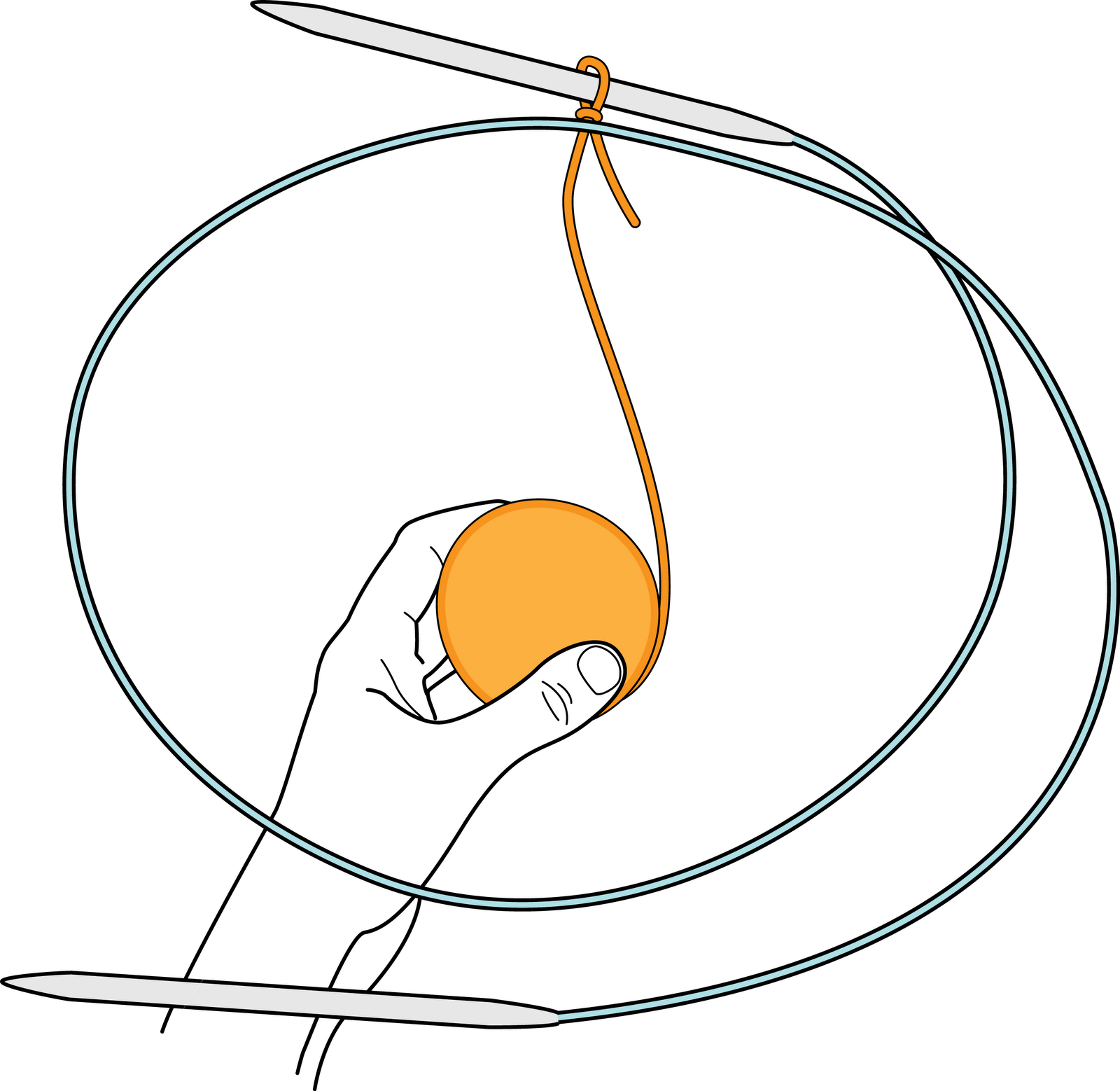
Step 1Tie a slip knot into the end of the yarn, and place it on your R needle.
Loop the cable around, and lay it in front of the knot and the working yarn.
Hold the yarn behind the needle and cable.
It should look like this:

Step 2
Release the yarn and move your hand around to the front of the cable.

Step 3
Grasp the ball of yarn from the front of the cable.

Step 4
Holding the yarn, bring your hand above the needle.

Step 5
Bring your hand back down below the needle. Yarn now wraps around the needle and cable.
This is your first Moebius stitch. When counting sts for final width, count this wrap as one stitch.

Repeat steps 2-5 to make more wraps. As you continue to wrap, slide your cast-on stitches to the right, so they slide off the R needle and onto the cables.

By the way, as you slide your wraps onto the cables, do not pull out the extra slack. The wraps need to be loose enough to slide around and onto your other needle.
When you’ve cast on enough sts to go all the way around your cable needle, your work should look something like this. Place a stitch marker on your right needle to indicate your starting point. Work the first stitch on the L needle, indicated with the arrow.

With your stitch marker in place, work the first stitch on the L needle and continue around.
Notice how your slipknot is now on the cable. It started out on the R needle, and as you continued to cast on your moebius stitches, it moved clockwise around your cable to this position.
After you’ve worked all the cast on stitches (once around, or half of 1 moebius round), your slipknot will be on the tip of your L needle, and your stitch marker will be on the cable. Pretty cool, eh?
So, now you know how I like to do it. But if you, like me, are still curious about other ways to cast on for your moebius, here are some links you might find interesting.
Toroidal Snark - sarah-marie belcastro describes a variety of ways for casting on.
Iris Schreier's moebius cast on - video demonstrating an alternative way of casting on -- the result is kindof like Judy's Magic Cast On a-la-moebius.